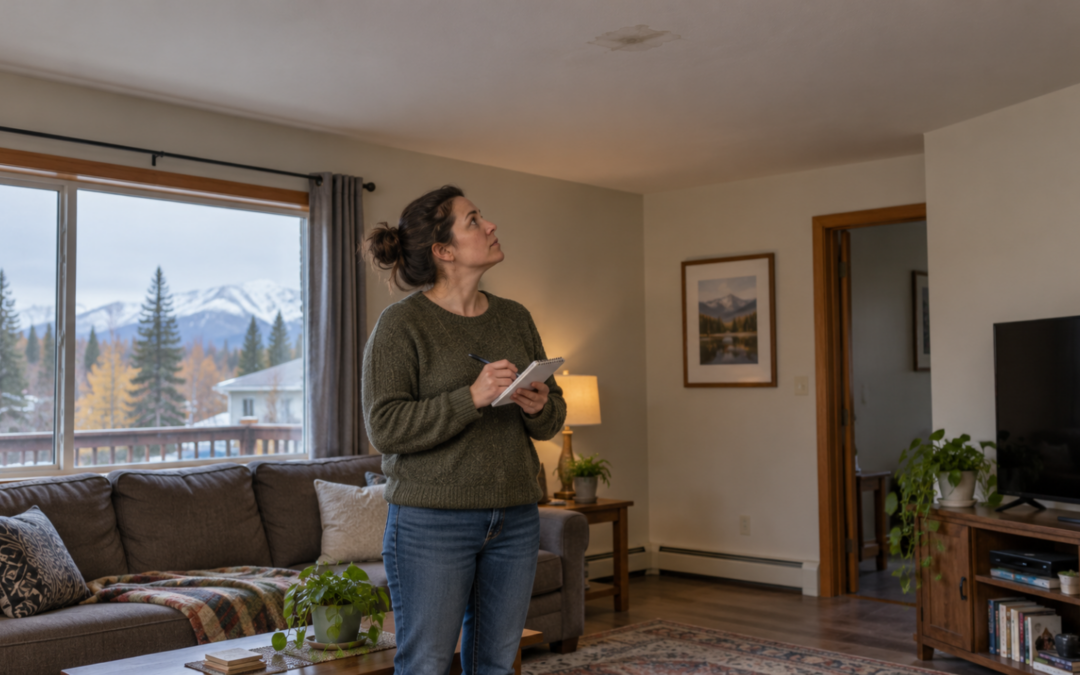
A ceiling stain was reported, someone attended the property, and the mark later looked less noticeable. Now the resident has reported it again.
The new report may be treated as a separate task. The previous assessment is somewhere in an email thread, the service note is attached to an invoice, and nobody is certain whether the earlier work addressed a source or only the surface appearance.
The next useful step is to connect the history while arranging the appropriate response. A recurring stain is an observation. It does not identify the cause or establish the condition of materials that cannot be seen.
For Alaska rental owners, October is a practical time to improve these records before winter operations add more demands to the maintenance queue.
Respond to the Current Condition First
If water is actively entering the property or the area presents a safety concern, follow the property’s urgent-response procedures. Do not delay an appropriate professional assessment while searching for a perfect archive.
Keep occupants away from unsafe areas. Do not ask anyone to touch wet electrical fixtures, investigate a sagging ceiling, climb into a cavity, or disturb suspect material.
For a stable visible mark, record what is currently observed and arrange the suitable next assessment. The current condition and the previous record can be addressed in parallel.
Avoid assuming that a returning mark proves the same cause as before. The location may be familiar while the underlying situation has changed.
Find the Exact Location in the Previous Record
Use consistent room and surface references. “Living-room ceiling near the exterior-facing window” is more useful than “upstairs stain.”
Compare the new observation with earlier photographs where those images were taken safely and retained with permission. Look for differences in the visible boundary, discoloration, or surrounding area.
Photographs should have dates and context. A close crop without a room reference may be difficult to interpret later. A wider view can help establish location, while a closer image records appearance.
Do not post resident interiors publicly as part of a maintenance update. The record belongs in the authorized property-management channel.
If the earlier location is uncertain, say so. An approximate match should not become a confirmed conclusion.
Separate Observations From Professional Findings
Create a simple chronology with four distinct types of information: what was reported, what the professional assessed, what action occurred, and what follow-up was recommended.
This distinction prevents a resident’s description or a coordinator’s guess from being mistaken for a technical diagnosis.
For example, “resident reports staining after a recent wet period” is an observation about timing. It does not confirm a roof leak. Similarly, “surface repainted” records a cosmetic action but does not establish that a moisture source was corrected.
Ask the qualified provider to explain any conclusion, its limitations, and the next assessment needed. Retain those findings in the provider’s wording where appropriate.
A history that preserves uncertainty can be more useful than one that supplies an answer nobody actually established.
Look for the Missing Source-Correction Record
The EPA’s home moisture guide explains that moisture control is central to mold control and that cleaning without fixing the water problem can allow it to return.
The operational question for an owner is whether the record establishes what happened to the source. Cosmetic improvement alone does not answer that question.
Locate the service report describing any source correction and related drying or follow-up recommendations. If those details are missing, request clarification from the provider or arrange the next appropriate professional assessment.
This is not an instruction to open the ceiling or perform remediation. Hidden conditions and suspect materials need suitable professional handling.
Build a Chronology the Next Professional Can Use
A useful history does not require an elaborate report. A compact sequence can include:
- Date and exact location of the first report
- What the resident or property contact observed
- Name and role of the assessing professional
- Findings and limitations recorded
- Work performed and its date
- Outstanding recommendations
- Later observations at the same location
- Current assigned action and review date
Keep original reports with the chronology rather than replacing them with a summary. The next provider may need details that the summary omits.
Record relevant conditions factually. If a resident reports a timing pattern, identify it as reported information rather than a confirmed explanation.
Avoid collecting unrelated household information. Include what is relevant to the assessment and handle it privately.
Coordinate the Follow-Up Visit
Tell the provider that the condition has been reported before and supply the earlier record. Confirm the purpose of the new visit.
The visit may be to investigate a recurrence, check previous work, or assess an outstanding recommendation. These are different purposes and should be described accurately.
Arrange access through the property’s applicable procedures. Give the resident a clear explanation of the next appointment or update, without promising an outcome that remains uncertain.
If more than one specialist is involved, identify who coordinates the findings. Separate reports can otherwise produce another gap between assessment and action.
A Hypothetical Rental Example
A resident in a Wasilla rental reports a faint ceiling mark near a window. An earlier record notes that the surface was treated, but it contains no clear finding about the moisture source.
The owner supplies that record to the next qualified professional and explains that the condition has returned. The new assessment is arranged to address the recurrence rather than assume the earlier cosmetic treatment resolved it.
This hypothetical example does not represent a Pivot client or diagnose a building. It shows how a missing finding changes the next maintenance question.
The useful outcome of the documentation is a clearer assessment brief, not an automatic answer.
Decide How the Item Will Stay Visible
If the investigation is incomplete, keep the item open with a named next action. If the professional recommends follow-up observation, record what should be observed, by whom, and when.
A follow-up date is not permission to ignore a worsening condition. New water, damage, or safety concerns should be reported promptly through the appropriate channel.
Keep technical confirmation separate from routine observation. A resident can report whether the mark appears to have changed. A qualified professional determines the technical significance and any further work.
Pivot’s Lease Inspections and Property Reviews provide documented observations and recommended next steps. An inspection finding can then connect to the appropriate specialist work.
Preserve the History Beyond This Visit
Once the action is completed, retain the findings, service details, limitations, and any ongoing recommendation. The next report should be able to connect to that history.
A returning stain should not force everyone to start from memory. Clear records give the next professional a better understanding of what was observed and what has already been addressed.
For help documenting property condition and organizing the resulting next steps, explore Pivot’s property review service.
Recent Comments