
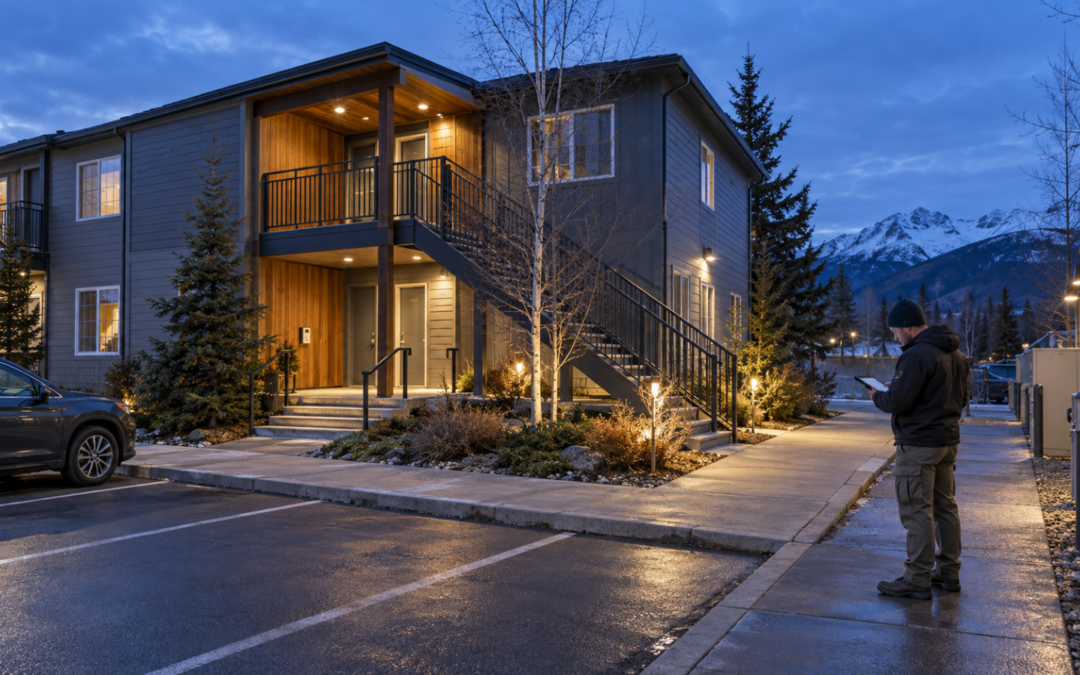
Exterior lighting is easy to overlook during Alaska’s brighter months. A fixture may still turn on, but that does not mean it lights the right area, operates at the right time, or remains reliable in wet and cold conditions.
As daylight decreases, lighting becomes part of everyday property operations. Residents need to see steps and entry surfaces. Employees and customers need clear routes between parking areas and doors. Maintenance teams need visibility around service areas, equipment, dumpsters, and loading zones.
An exterior lighting check should therefore be more than a quick bulb count. It should evaluate how people actually approach, enter, leave, and work around the property after dark.
Perform the Inspection After Dark
A daytime inspection can identify cracked lenses, loose fixtures, corrosion, exposed wiring, or physical damage. It cannot show how the lighting system performs when people need it most.
Schedule at least part of the inspection after sunset. Walk the same routes used by residents, employees, customers, vendors, and maintenance personnel. View the property from both directions because a fixture that seems adequate from the building may leave the parking approach or stair landing in shadow.
Bring a simple route list so the inspection covers the entire site:
- Primary and secondary entrances
- Exterior stairs, ramps, and landings
- Walkways between parking and the building
- Driveways and parking areas
- Mail, trash, and recycling locations
- Mechanical and utility access points
- Service doors and delivery areas
- Loading zones
- Shared yards, courtyards, and exterior corridors
- Emergency exit discharge routes at commercial properties
Do not rely on memory. A documented route prevents low-traffic areas from being skipped.
Look Beyond Burned-Out Lamps
A light can be operating and still need maintenance. During the walkthrough, check for:
- Flickering, delayed startup, or intermittent operation
- Dirty, clouded, cracked, or moisture-filled lenses
- Fixtures aimed away from the intended route
- Vegetation, signs, snow-storage plans, or building features blocking the light
- Deep shadows at steps, curbs, ramps, or surface changes
- Excessive glare that makes nearby areas harder to see
- Mismatched color or brightness that obscures visual transitions
- Loose housings, visible corrosion, or physical impact damage
- Fixtures that cycle on and off unexpectedly
- Controls that activate too late or shut lights off while the property is still in use
The inspection should focus on visibility and function, not simply brightness. Adding more light is not always the right answer. Correct aiming, clean lenses, working controls, and attention to shadowed transitions can be just as important.
Check Timers, Photocells, and Other Controls
Lighting schedules that worked in summer may no longer match fall use. Mechanical timers can drift or remain set for a previous daylight pattern. Photocells can become dirty, obstructed, or affected by nearby light sources. Motion controls may have blind spots or shut fixtures off too quickly for the route being served.
The U.S. Department of Energy notes that timers and photocells can operate exterior lighting at seasonally appropriate times. For property owners, this means controls should be tested as part of maintenance rather than assumed to be working correctly.
Confirm that:
- Lights activate before the area becomes difficult to navigate.
- Fixtures remain on for the full period the route is in use.
- Motion sensors detect people approaching from expected directions.
- Photocells are clean and not falsely triggered by another fixture.
- Timers reflect the current season and operating schedule.
- Manual overrides are labeled and accessible to authorized personnel.
- A responsible person knows how to report a control failure.
Commercial properties may also have building automation schedules, security requirements, or tenant operating hours that affect lighting. Changes should be coordinated with the appropriate facility, electrical, or security personnel.
Match the Check to the Property Type
Residential and commercial properties share the need for visible access, but their priorities are not identical.
Residential Properties
For a single-family rental, duplex, or small multifamily property, begin with the routes occupants use every day. Check porch lights, unit entrances, exterior stairs, shared walkways, parking approaches, trash areas, and mail locations.
Pay attention to who is responsible for replacing lamps, reporting failures, and keeping controls switched on. If a wall switch can accidentally disable an important exterior fixture, labeling or another approved control arrangement may help reduce confusion.
Commercial Properties
Commercial buildings often need a more formal inspection route. Include customer entrances, employee doors, delivery zones, accessible routes, loading areas, service yards, parking areas, and exit discharge paths.
OSHA requires covered workplace walking surfaces to be inspected and maintained, and its exit-route standard states that each exit route must be adequately lighted. Owners and employers should review the requirements that apply to their property and operations. The relevant federal references include OSHA Standard 1910.22 for walking-working surfaces and OSHA Standard 1910.37 for exit-route maintenance and lighting.
These references should not be treated as a substitute for property-specific code, lease, fire-safety, or professional guidance.
Review Lighting Together With Surface Conditions
Lighting and walking-surface maintenance should be reviewed together. A fixture may illuminate a clear sidewalk adequately but leave a water-filled depression, damaged stair edge, or snow-covered curb difficult to recognize.
During the nighttime walkthrough, look for combinations of conditions:
- A dark area where runoff or refreezing is already known to occur
- A stair or ramp where the first or last step blends into the landing
- A parking route where pedestrians and vehicles share limited space
- A dumpster or service area with uneven ground
- An entrance where glare from one fixture hides the surface beyond it
- A loading area where equipment or stored materials block light
When lighting reveals a separate surface, drainage, or access problem, create a second work order rather than treating the fixture adjustment as the complete correction.
Make Reporting Easy
Exterior lighting problems frequently develop between formal inspections. Residents, tenants, employees, security staff, cleaning teams, and vendors may notice a failure first.
Give them a simple reporting method. A useful report includes:
- The exact fixture or location
- The date and approximate time
- Whether the light was completely out, flickering, cycling, or activating late
- A photo from a safe position, if practical
- Whether the condition affects an entrance, stair, parking route, or service area
Avoid vague descriptions such as “the outside light is broken.” Numbering fixtures or naming zones can make reporting and dispatch much faster on larger sites.
Turn the Inspection Into a Repeatable Maintenance Record
A lighting check is more valuable when it produces a record that can be compared over time. For each problem, document:
- Location and fixture identifier
- Observed condition
- Access or operational impact
- Temporary measure, if one was needed
- Person or vendor assigned
- Completion date
- Repair or replacement performed
- Nighttime verification after completion
The last step is important. A repair may restore power without correcting aim, shadow, glare, timing, or sensor coverage. Verify performance under the conditions in which the light is actually used.
Property managers overseeing several buildings can also review repeated failures by fixture type, location, exposure, or age. That history may support more informed maintenance planning instead of repeated one-off replacements.
Know When the Work Requires a Qualified Professional
Property staff may be able to clean an accessible lens, update an approved timer, or submit a work order. They should not open fixtures, handle damaged wiring, use unsafe ladders, or attempt electrical repairs outside their training and authority.
Visible electrical damage, water inside a fixture, recurring breaker trips, overheated components, damaged poles, and inaccessible elevated fixtures should be evaluated by an appropriately qualified professional. Follow the manufacturer’s instructions and the requirements that apply to the property.
A Short Exterior Lighting Maintenance Checklist
Use this list before Alaska’s darker months:
- Walk every normal access route after dark.
- Confirm entrances, stairs, ramps, and landings are visible.
- Inspect parking, delivery, service, mail, and trash routes.
- Test timers, photocells, motion sensors, and manual controls.
- Clean accessible lenses and remove safe, minor obstructions.
- Record flickering, moisture, corrosion, damage, glare, and shadowed areas.
- Compare lighting with known ice, drainage, and surface hazards.
- Confirm commercial exit routes and emergency lighting are addressed under the applicable plan.
- Assign repairs through a documented work order.
- Verify the completed work after dark.
Lighting Is Part of Property Readiness
Exterior lighting supports more than appearance. It helps occupants and workers recognize entrances, stairs, surface changes, and travel routes during the hours the property is in use.
The best time to find lighting gaps is before darkness, snow, and ice all begin affecting the same route. A deliberate nighttime inspection gives owners and managers a clearer view of what is working, what is hidden, and what should be corrected before winter operations become more demanding.
Pivot Maintenance Management can help residential and commercial owners organize exterior lighting observations, create and track work orders, and coordinate follow-up as part of a broader preventative maintenance plan. A documented nighttime walkthrough is a practical place to begin.
Recent Comments